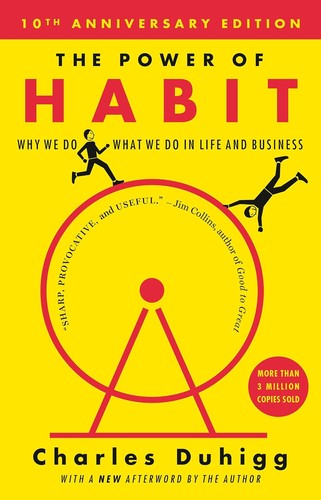
Why do you check your phone the moment you sit down to study? Why does one small change — a morning walk, a fixed bedtime — sometimes change everything else too? This The Power of Habit Book Review is about a book that answers those questions with real science and real stories. In The Power of Habit: Why We Do What We Do in Life and Business, Charles Duhigg, a New York Times reporter, explains how habits work in the brain — and how anyone can rebuild them.
Duhigg led the New York Times team that won the 2013 Pulitzer Prize for “The iEconomy”, and his book became a bestseller on the New York Times, Amazon and USA Today lists after it was published in February 2012 by Random House. In this The Power of Habit Book Review, I explain the book’s key ideas in simple language, and how students can use them to study better, waste less time, and build routines that actually last.
The Power of Habit by Charles Duhigg: Quick Facts
- Author: Charles Duhigg
- First published: February 2012 (Random House)
- Publisher: Random House
- Pages: 400 (hardcover); 371 (paperback)
- Structure: Three parts — habits of individuals, habits of organisations, habits of societies — plus a four-step appendix
- Best for: Students, young professionals, and anyone who wants to change a habit that will not change
What Is The Power of Habit About?
The book is built around one discovery from brain research at MIT: every habit runs on a simple neurological loop with three parts. A cue triggers the behaviour, a routine follows, and a reward tells the brain the loop is worth remembering. Once the loop is learned, the brain stops making decisions and runs it on autopilot. That is why habits feel effortless — and why they are so hard to break.
Duhigg tells the science through stories. A man named E.P. lost his memory to viral encephalitis and could not remember what he had for breakfast — yet he could still learn new habits, because habits live in a different part of the brain from memory. A company, a coffee chain, a church and a civil rights movement all turn out to run on the same loop. The book’s message is hopeful: habits are not fate. Once you can see the loop, you can change it.
Key Lessons from The Power of Habit
1. The Habit Loop: Cue, Routine, Reward
Every habit has three parts. The cue is the trigger — a time, a place, a feeling, the people around you, or the action you just finished. The routine is the behaviour itself. The reward is what your brain gets out of it, and it is what makes the loop stick.
Duhigg shows that almost all cues fall into five categories: location, time, emotional state, other people, and the immediately preceding action. For a student, that is a practical checklist. If you always open social media when you sit at your desk at 8 p.m. feeling bored, the cue is not your phone — it is the desk, the time, and the boredom. Change the cue, and the loop has nowhere to start.
2. Cravings Drive Every Habit
The loop only becomes a habit when the brain starts to crave the reward. Duhigg describes how Procter & Gamble used this research to sell Febreze: the spray only became a habit for customers once they learned to crave the fresh smell at the end of cleaning — the reward, not the product, was the point.
The same rule explains your own habits. You do not check your phone because you need information. You check it because your brain craves the small reward of something new. This The Power of Habit Book Review keeps coming back to this point because it changes how you fix a habit: do not fight the craving. Give it a different routine that delivers the same reward.
3. The Golden Rule of Habit Change
You cannot simply delete a bad habit, Duhigg argues. You have to replace it. The Golden Rule of habit change is: keep the old cue, deliver the old reward, but insert a new routine. A smoker who craves the break and the chat with colleagues, for example, can keep the break and the chat — and drop the cigarette.
There is one more ingredient: belief. Duhigg tells the story of Bill Wilson, whose faith led him to create Alcoholics Anonymous, to show that people change more easily when they believe change is possible — and that groups, accountability partners and communities make belief easier to hold. Changing a habit alone is hard. Changing it with other people is far easier.
4. Keystone Habits Change Everything
Some habits matter more than others. Duhigg calls them keystone habits: small changes that set off a chain of other changes without any extra effort. People who start exercising regularly often start eating better and become more productive at work, not because they decided to, but because one change spills into the rest of life.
The most famous example is Alcoa. When Paul O’Neill became chief executive, he ignored profits and focused on one thing: worker safety. That single keystone habit forced the whole company to change how it communicated and worked — and Alcoa’s market capitalisation rose by $27 billion. For a student, the lesson is direct: do not try to fix ten habits at once. Find the one keystone habit — a fixed study hour, a morning walk, a phone-free desk — and let it pull the others along.
5. Willpower Can Become a Habit
The book calls willpower “the single most important keystone habit for individual success”. Duhigg shows how Starbucks trains its staff to handle angry customers and long shifts: willpower is not something you are born with, it is a routine you practise until it becomes automatic. The research he cites suggests willpower behaves like a muscle — it can be tired out, but it can also be strengthened with practice.
For students, this reframes every exam season. You do not need more willpower to study. You need a routine that makes studying the automatic response to a cue — the same desk, the same time, the same first step — so that willpower is not spent on deciding to start.
6. Companies Know Your Habits — Sometimes Before You Do
In the book’s most unsettling chapter, Duhigg explains how the retailer Target studied shopping patterns to predict customers’ needs, including major life changes, before the customers announced them. The chapter grew out of his 2012 New York Times article “How Companies Learn Your Secrets”.
The point is not to fear shopping data. It is to notice how predictable your own loops are: if a company can read your habits from your receipts, you can read them yourself — and that is the first step to changing them.
7. Habits Can Change Societies
The final part of the book zooms out. Duhigg shows how the Montgomery bus boycott and Saddleback Church grew the same way a personal habit grows: a cue, a routine shared by a community, and a reward that keeps people coming back. Movements, he argues, are habits held by groups of people.
It is a big claim, and it is why the book ends with a chapter on free will: are we responsible for our habits? Duhigg’s answer is yes — once you understand the loop, you can choose what to do with it.
How Students Can Use The Power of Habit
- Find your cue: For one week, note the time, place, mood and people around you every time a bad study habit appears. The pattern will show itself.
- Keep the cue and the reward, swap the routine: If boredom at your desk sends you to your phone, keep the desk and the break — replace scrolling with a short walk or a glass of water.
- Pick one keystone habit: A fixed study hour, a phone-free desk, or a morning walk. One small change can pull better sleep, better focus and better grades behind it.
- Practise willpower in small doses: A short daily routine you never skip — ten minutes of revision, one page of reading — builds the muscle that carries you through exam season.
- Change with other people: Study with a partner or a group. Belief and accountability make a new routine far easier to hold.
- Design your environment: Put your phone in another room and your books on the desk. The easiest habit to keep is the one your surroundings already support.
If you like books that turn psychology into practical life skills, you may also enjoy our Atomic Habits Book Review and our Deep Work Book Review — both are about building better systems for learning and focus. And if you want the money side of behaviour, read our The Psychology of Money Book Review too.
Get your copy of The Power of Habit on Amazon
As an Amazon Associate, I earn from qualifying purchases.
Who Should Read The Power of Habit?
This book is an excellent choice for students who keep starting good routines and abandoning them, for anyone who wants to understand why they do what they do, and for readers who enjoy science told through stories. It is written in clear, simple English, and its three parts — individuals, organisations, societies — mean there is something here for every reader. No background in psychology is needed.
The book is not perfect. As the New York Times Book Review noted, it is “an entertaining book” and “a serious look at the science of habit formation”, but it is “not always clear” how to turn its stories into a step-by-step prescription for change. Some of the science is also simplified: later research has questioned whether willpower really works like a muscle, and the famous “more than 40% of what we do each day is habit” figure depends on how habit is measured. Read it for the framework and the stories, not as a laboratory manual. Even with those limits, this The Power of Habit Book Review recommends it as one of the best first books about behaviour change.
Frequently Asked Questions
What is the habit loop in The Power of Habit?
The habit loop has three parts: a cue that triggers the behaviour, a routine (the behaviour itself), and a reward that tells the brain the loop is worth remembering. Every habit Duhigg describes — from brushing teeth to running a company — follows this loop.
What is the golden rule of habit change?
Keep the old cue, deliver the old reward, but insert a new routine. You cannot erase a bad habit; you replace it. Belief — often supported by a group or community — is what makes the new routine stick.
What is a keystone habit?
A keystone habit is a small change that triggers a chain of other positive changes. Duhigg’s examples include exercise, which often leads to better eating and better work habits, and worker safety at Alcoa, which transformed the whole company.
Is The Power of Habit a good book for students?
Yes. It is one of the best books for students who want to study better and waste less time, because it explains the mechanics of habits in plain language and gives a usable method: find the cue, swap the routine, keep the reward.
How long is The Power of Habit by Charles Duhigg?
The hardcover edition has 400 pages and the paperback has 371 pages. It is made up of three parts and an appendix, and most readers finish it in a week or two.
What is the difference between The Power of Habit and Atomic Habits?
The Power of Habit (2012) explains the science of how habits work, through the cue-routine-reward loop and stories from labs, companies and movements. Atomic Habits (2018) by James Clear builds on the same science and turns it into a practical four-step system for building good habits and breaking bad ones. They work well together: read Duhigg for the why, Clear for the how.
The Power of Habit Book Review: Final Verdict
The Power of Habit is a book every student should read before blaming themselves for a lack of discipline. It does not ask you to try harder. It shows you that your behaviour runs on loops — and that once you can see the cue, the routine and the reward, you can rebuild the loop on purpose. Find one keystone habit, keep your cues, swap your routines, and let belief and other people carry you through the hard weeks.
For that reason, this The Power of Habit Book Review gives the book a firm recommendation. Read it once to understand your habits, and keep its loop in mind every time you sit down to study. Your future self — the one with steady routines and time to spare — will thank you for starting now.
Available on Amazon
The Power of Habit by Charles Duhigg
As an Amazon Associate, I earn from qualifying purchases.