Most money books teach you formulas: how to invest, how to budget, how to pick stocks. This The Psychology of Money Book Review is about a book that does something different. In The Psychology of Money: Timeless Lessons on Wealth, Greed, and Happiness, Morgan Housel argues that doing well with money has surprisingly little to do with how smart you are, and a lot to do with how you behave.
Housel is a partner at The Collaborative Fund and a former columnist at The Motley Fool and The Wall Street Journal. He spent years watching clever people make terrible money decisions, and his conclusion is simple: money is not a maths problem. It is a behaviour problem. In this The Psychology of Money Book Review, I explain the book’s key lessons in simple language, and how students can use them long before they earn their first salary.
The Psychology of Money Book Review: Quick Facts
- Author: Morgan Housel
- First published: 8 September 2020 (Harriman House)
- Publisher: Harriman House
- Pages: 256
- Structure: 19 short stories, each about one idea
- Best for: Students, young professionals, and anyone who wants a healthier relationship with money
This The Psychology of Money Book Review explains the book’s biggest ideas in plain English, so you can decide quickly whether it is worth your time.
What Is The Psychology of Money About?
The book is made of 19 short, self-contained chapters. Each one tells a story — a janitor who died rich, an executive who lost everything, a gambler, a teacher, an investor — and draws one lesson from it. You can read the chapters in any order, and each one takes only a few minutes.
The central claim runs through all of them: your personal experience with money shapes your beliefs far more than any textbook. Someone who grew up in a time of high inflation thinks about saving very differently from someone who grew up in a boom. Neither of them is crazy. They just learned different lessons from different lives. Once you accept that, you stop judging other people’s money choices — and you start understanding your own.
Key Lessons from The Psychology of Money Book Review
1. No One’s Crazy
Housel’s opening idea is that every money decision makes sense to the person making it, given what they have lived through. A person who watched their parents lose a job in a recession will save aggressively. A person who grew up in good times may spend freely. Both are reasonable from their own history.
For students, this lesson is about humility: before you copy someone’s money habits — or criticise them — ask what experiences shaped them. And when you make your own choices, notice that your view of money is only a tiny slice of how the world actually works.
2. Luck and Risk Are Two Sides of the Same Coin
Every outcome in life is guided by forces beyond effort. Housel shows how luck and risk look identical from the outside: we praise the lucky and blame the unlucky, even when their decisions were the same.
The book’s most famous example is Ronald Read, a Vermont janitor and petrol station attendant who died with about $8 million. He never earned a high salary. He saved patiently, invested steadily, and let time do the work. Compare that with Richard Fuscone, a highly educated finance executive who borrowed heavily and lost almost everything. Knowledge alone did not decide the outcome. Behaviour did.
3. Never Enough: Know When to Stop
One of the book’s darkest chapters tells the story of Rajat Gupta, a man who had wealth, respect, and a brilliant career — and risked it all because he wanted more. Housel calls this the problem of moving goalposts: no matter how much you have, “enough” keeps moving further away.
The lesson is one of the most useful in the whole book. Decide what “enough” means for you, in advance. Without that line, every raise, every bonus, and every success just creates a bigger target — and the chase never ends.
4. Compounding Needs Time, Not Brilliance
Housel argues that Warren Buffett’s fortune owes as much to how long he has invested as to how well he has invested. Buffett started young and kept going for decades. Compounding — earning returns on your returns — is slow at first and then suddenly powerful.
This is the most hopeful lesson in the book for students. You do not need a large amount of money to benefit from compounding. You need time, and you need to start. A small amount saved regularly from a young age can grow far more than a large amount saved late. Time is the one advantage young people have over everyone else, and it costs nothing.
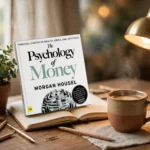
Get your copy of The Psychology of Money on Amazon
5. Getting Wealthy and Staying Wealthy Are Different Skills
Getting wealthy often takes risk, optimism, and bold moves. Staying wealthy takes the opposite: humility, caution, and the understanding that what you made can be taken away quickly. Housel’s rule for staying wealthy is simple: survival. Avoid the big mistake. Do not lose everything in one bad decision.
For a student, this means building habits that protect you: keep an emergency fund, avoid high-interest debt, and do not gamble money you cannot afford to lose. Boring habits are what keep wealth alive.
6. Wealth Is What You Don’t See
A fast car and a big house are signs of money spent, not money kept. Housel points out that real wealth is invisible: it is the money you did not spend. The person driving an old car may be far richer than the person driving a new luxury car, because wealth is what remains after spending.
This changes how you should judge success. Do not compare yourself with people who look rich. Compare your savings rate, your freedom, and your peace of mind. Those are the real numbers.
7. Freedom Is the Highest Dividend Money Pays
The book’s most quoted idea is that the highest form of wealth is the ability to wake up every morning and say, “I can do whatever I want today.” Money’s greatest value is not what it buys. It is the control it gives you over your time.
Housel writes that controlling your time is the one thing money can buy that reliably increases happiness. A higher salary that steals all your time is a bad trade. A modest income that leaves you free to choose how you spend your days is a good one.
8. Reasonable Beats Rational
A perfectly rational plan that you abandon in a bad year is worthless. A reasonable plan that you can actually stick with is priceless. Housel argues for plans that fit your personality — saving an amount you can sustain, investing in a way that lets you sleep at night — rather than the mathematically optimal plan you will quit at the first crash.
How Students Can Use The Psychology of Money Book Review
- Start saving early, even tiny amounts: Compounding rewards time more than size. Even a small regular saving habit in your student years builds the muscle that matters later.
- Decide what “enough” means: Before your income grows, write down what a good life costs you. That number protects you from the endless chase for more.
- Save without a specific goal: Housel argues that saving just to have flexibility — money for opportunities and emergencies — is one of the smartest reasons to save.
- Leave room for error: Every plan should survive surprises. Keep a buffer, avoid debt you cannot repay, and never bet everything on one outcome.
- Spend on time, not on status: The book’s freedom lesson applies even on a student budget. Buy back an hour of your time when you can, and skip the purchase that only exists to impress others.
- Learn from other people’s money stories: Read about how others made and lost money. Their experience is free education.
If you like books that turn psychology into practical life skills, you may also enjoy our Atomic Habits Book Review and our Deep Work Book Review — both are about building better systems for learning and focus.
Who Should Read The Psychology of Money?
This book is an excellent choice for students who want to understand money before they start earning it, for young professionals making their first salary decisions, and for anyone who feels anxious about finances. It is written in clear, simple English, with stories that are easy to follow and remember. No background in finance is needed — the book assumes you know nothing and explains everything through real people.
The book is not perfect. Some readers will want more practical detail: exact investment steps, budgeting methods, or numbers to follow. Housel deliberately avoids those. This is a book about thinking, not a manual. A few of the stories are also told loosely, so read it for the lessons rather than treating every anecdote as precise history. But as a first book about money, it is hard to beat.
Frequently Asked Questions
What is the main idea of The Psychology of Money Book Review?
The main idea is that doing well with money depends more on how you behave than on what you know. Your experiences, your patience, your attitude to risk, and your idea of “enough” matter more than any formula or investment tip.
Is The Psychology of Money a good book for students?
Yes. It is one of the best first books about money a student can read, because it teaches the mindset before the mechanics. It is short, written in simple English, and its lessons apply whether you earn a little or a lot.
How long is The Psychology of Money by Morgan Housel?
The paperback edition has 256 pages, made up of 19 short chapters. Most readers finish it in a few days, and the chapters work well one at a time.
What is the Ronald Read story in The Psychology of Money?
Ronald Read was a Vermont janitor who died with about $8 million. He earned a modest salary all his life, saved patiently, and invested steadily for decades. Housel uses his story to show that behaviour and time matter more than income or financial knowledge.
What does “wealth is what you don’t see” mean?
It means real wealth is the money you did not spend. Expensive cars and houses show spending, not wealth. The money that remains — savings, investments, and freedom — is invisible, and it is the part that actually makes you wealthy.
The Psychology of Money Book Review: Final Verdict
In this The Psychology of Money Book Review, the verdict is simple: The Psychology of Money is a book every student should read before their first pay cheque. It does not teach you to pick stocks or build a budget. It teaches you something more important: how to think about money without letting it control you. Save patiently, know what enough means, protect your time, and leave room for error.
For that reason, this The Psychology of Money Book Review gives the book a firm recommendation. Read it once for the stories, and keep its lessons for life. Your future self — the one with savings, freedom, and peace of mind — will thank you for starting now.
Available on Amazon
The Psychology of Money by Morgan Housel
As an Amazon Associate, I earn from qualifying purchases.