Some books give you tips. This one gives you a way of thinking. This The 7 Habits of Highly Effective People Book Review is about a book first published in 1989 that is still one of the best-selling self-help books in the world — Stephen R. Covey‘s The 7 Habits of Highly Effective People: Powerful Lessons in Personal Change. More than 20 million copies had sold by the time Covey died in 2012, and the seven habits are still taught as a course by FranklinCovey today.
Covey’s argument is simple and serious: lasting success does not come from quick techniques or a better image. It comes from character — from principles like fairness, integrity, honesty and human dignity. He calls this the “character ethic”, and contrasts it with the “personality ethic” of quick fixes. Change, he argues, works from the inside out: first you, then your relationships, then your results. In this The 7 Habits of Highly Effective People Book Review, I explain all seven habits in simple language, and how students can use them to study better, manage time, and work well with other people.
The 7 Habits of Highly Effective People by Stephen R. Covey: Quick Facts
- Author: Stephen R. Covey
- First published: 1989 (Free Press, Simon & Schuster)
- Publisher: Free Press (Simon & Schuster)
- Pages: 391 (25th Anniversary Edition, 2013)
- Structure: Four parts — Paradigms and Principles, Private Victory (Habits 1–3), Public Victory (Habits 4–6), Renewal (Habit 7)
- Best for: Students, young professionals, and anyone who wants a principled way to organise their life and work
- Reviewed here: The 7 Habits of Highly Effective People Book Review — a student-friendly guide to Covey’s seven habits.
This The 7 Habits of Highly Effective People Book Review starts with the facts you need before you read the book.
What Is The 7 Habits of Highly Effective People About?
The book opens with a big idea: a paradigm. A paradigm is the lens you see the world through, and Covey argues that two people can look at the same facts and see completely different things. Before you can change your behaviour, you may need to change how you see. That is why the book is arranged as a journey along what FranklinCovey calls the Maturity Continuum — from dependence, to independence, to interdependence.
This The 7 Habits of Highly Effective People Book Review explains paradigms first, because Covey does.
The first three habits build the Private Victory: mastering yourself. The next three build the Public Victory: working well with other people. The seventh habit, Sharpen the Saw, is renewal — the upkeep that makes the other six last. The order is the argument. Private victories come before public ones, so a student who skips to teamwork before learning to manage themselves is starting in the middle.
This The 7 Habits of Highly Effective People Book Review follows Covey’s own order, from paradigms to renewal.
The Seven Habits Explained
Each habit below is explained in the order Covey gives it in this The 7 Habits of Highly Effective People Book Review.
Habit 1: Be Proactive
Being proactive means taking responsibility for how you react to life. Covey draws on the psychiatrist Viktor Frankl: between stimulus and response lies your freedom to choose. Nothing can hurt you without your consent.
His practical tool is the Circle of Influence and the Circle of Concern. Your Circle of Concern holds everything you worry about — exam dates, other people’s opinions, the economy. Your Circle of Influence holds what you can actually change — your preparation, your attitude, your next hour. Proactive people shrink their worry by working on what they control; reactive people do the opposite, and their influence shrinks. For a student, the test is simple: when you complain about a subject, are you working on the part you control, or only worrying about the part you cannot?
This The 7 Habits of Highly Effective People Book Review begins with proactivity, because Covey does.
Habit 2: Begin with the End in Mind
Covey says all things are created twice: first in your mind, then in reality. Habit 2 asks you to picture what you want your life to stand for, and then plan backwards from there. His tool is the personal mission statement — a few sentences about what your role is for, written down and checked against your calendar.
It sounds like a business exercise, but for a student it is the difference between drifting and aiming. If your mission is to become a doctor, a teacher, or simply a person your family can rely on, then the choice between an hour of revision and an hour of scrolling answers itself. Begin with the end in mind, and every small decision gets easier.
That is why this The 7 Habits of Highly Effective People Book Review begins with your mission, not your timetable.
Habit 3: Put First Things First
This is the habit students feel most. Covey’s time management matrix divides everything you do into four quadrants: urgent and important (do it now — deadlines and crises), important but not urgent (plan it — long-term study, exercise, relationships), urgent but not important (delegate it — most interruptions), and neither urgent nor important (eliminate it — mindless scrolling).
Most students live in Quadrant I, firefighting deadlines, and Quadrant IV, wasting the hours in between. Covey’s point is that Quadrant II — the important but not urgent work — is where real progress lives. Revision done weeks before the exam, notes written the same day, a skill practised a little every day: none of it is urgent, and all of it is what makes the difference. Put first things first means scheduling Quadrant II before Quadrant I fills your week.
This The 7 Habits of Highly Effective People Book Review puts Quadrant II first, as Covey advises.
Habit 4: Think Win-Win
Habit 4 is a frame of mind: in every interaction, seek a result that benefits everyone. Covey contrasts it with win-lose thinking — the idea that someone has to lose for you to win — and with lose-win thinking, where you give in just to keep the peace. Win-win rests on an abundance mentality: the belief that there is enough success, credit and opportunity to go around.
In a study group, win-win means sharing notes instead of hoarding them, because a group that all does well lifts everyone. In a friendship, it means negotiating honestly instead of keeping score. It is not softness; it is the only strategy that keeps relationships working over time.
This The 7 Habits of Highly Effective People Book Review treats win-win as the habit that makes group work last.
Habit 5: Seek First to Understand, Then to Be Understood
Most people listen to reply, not to understand. Covey’s fifth habit is empathic listening: genuinely trying to see the world as the other person sees it, before offering your own view. He describes five common responses — evaluating, probing, advising and interpreting among them — and shows how they all shut the other person down.
When someone feels truly understood, Covey argues, they open up and become willing to listen in return. For students, this habit changes group work, friendships and family arguments alike. Understand first, and your own point lands far better when your turn comes.
This The 7 Habits of Highly Effective People Book Review treats listening as the habit that opens every other conversation.
Habit 6: Synergize
Synergy is the idea that the whole can be greater than the sum of its parts. When people with different strengths work together openly, they can reach a Third Alternative — a solution neither side would have found alone. Covey treats differences as a resource, not a problem: the classmate who thinks differently from you is not an obstacle, but the source of the better answer.
This is the habit that makes group study powerful. A group that only repeats what everyone already knows is a waste of time. A group that combines different notes, different questions and different strengths produces understanding no one had on their own.
This The 7 Habits of Highly Effective People Book Review treats synergy as the payoff for the first five habits.
Habit 7: Sharpen the Saw
The final habit is renewal. Covey tells of a man sawing a tree with a blunt saw, too busy to stop and sharpen it. The lesson is plain: you cannot keep producing if you never renew yourself. He describes four dimensions of renewal — physical (exercise, rest, food), mental (reading, learning), social and emotional (relationships, service), and spiritual (reflection, purpose) — and argues that a little renewal in each, every day, keeps the other six habits alive.
For a student, this is permission to sleep, to rest, and to do something other than study — not as laziness, but as part of the system. A rested mind learns faster than an exhausted one.
In this The 7 Habits of Highly Effective People Book Review, renewal is treated as part of the system, not a break from it.
How Students Can Use The 7 Habits of Highly Effective People
This The 7 Habits of Highly Effective People Book Review turns the seven habits into six practical steps for students.
- Draw your two circles: List everything you worry about, then split it into what you control and what you do not. Work only on the first list this week.
- Write a three-sentence mission statement: What is your study for? Read it every Sunday and check your calendar against it.
- Schedule Quadrant II first: Block two study sessions this week for important but not urgent work — revision, notes, practice — before anything else fills the time.
- Share before you compete: In your study group, share one useful note or summary each week. Win-win groups all score higher.
- Practise empathic listening: In your next disagreement, repeat the other person’s point in your own words before answering. Notice how the conversation changes.
- Sharpen the saw daily: A short walk, a chapter of reading, a real conversation. Renewal is not a reward for finishing — it is part of finishing.
If you like books that turn character into a practical system, you may also enjoy our Atomic Habits Book Review and our The Power of Habit Book Review — both are about building better routines for learning and focus. And if you want the money side of behaviour, read our The Psychology of Money Book Review too.
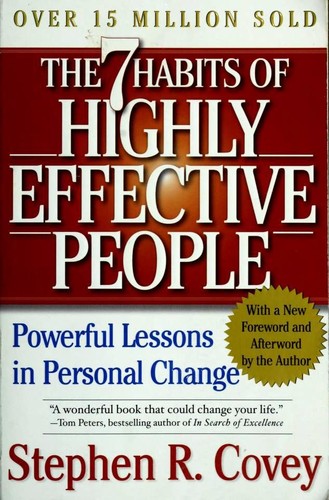
Get your copy of The 7 Habits of Highly Effective People on Amazon
As an Amazon Associate, I earn from qualifying purchases.
Who Should Read The 7 Habits of Highly Effective People?
This The 7 Habits of Highly Effective People Book Review is written for readers who want a clear verdict before they start the book.
This book is an excellent choice for students who feel busy but not effective, for anyone who wants to organise their time around what matters, and for readers who enjoy big ideas explained through stories and examples. No background in business or psychology is needed, and the habits build on each other so the book reads like a journey, not a list.
The book is not perfect. It was written in 1989, so some examples feel dated, and at nearly 400 pages it repeats its points more than a shorter book would. Some readers also find the habits more like a philosophy than a step-by-step method — Covey tells you what to aim for more than exactly how to do it on a Tuesday morning. Read it for the framework and the way of thinking, and pair it with a practical book like Atomic Habits for the daily routines. Even with those limits, this The 7 Habits of Highly Effective People Book Review recommends it as one of the most useful books a student can read before building their study system.
Frequently Asked Questions
These are the questions readers ask most in this The 7 Habits of Highly Effective People Book Review.
What are the 7 habits of highly effective people?
In this The 7 Habits of Highly Effective People Book Review, the seven habits are: 1. Be Proactive; 2. Begin with the End in Mind; 3. Put First Things First; 4. Think Win-Win; 5. Seek First to Understand, Then to Be Understood; 6. Synergize; 7. Sharpen the Saw. The first three build self-mastery (the Private Victory), the next three build teamwork (the Public Victory), and the seventh is renewal.
When was The 7 Habits of Highly Effective People published?
The book was first published in 1989 by Free Press (Simon & Schuster). It has been reissued several times, including a 15th Anniversary Edition in 2004, a 25th Anniversary Edition in 2013, and a 30th Anniversary Edition on 19 May 2020.
This The 7 Habits of Highly Effective People Book Review uses the 25th Anniversary Edition for its page count.
What is the time management matrix in The 7 Habits of Highly Effective People?
Under Habit 3, Covey divides activities into four quadrants by urgency and importance: Quadrant I is urgent and important (do it), Quadrant II is important but not urgent (plan it), Quadrant III is urgent but not important (delegate it), and Quadrant IV is neither urgent nor important (eliminate it). He argues that Quadrant II — the important but not urgent work — is where real progress happens.
Is The 7 Habits of Highly Effective People a good book for students?
Yes. It is one of the best books for students who feel busy but not effective, because it teaches them to work on what they control, plan around what matters most, and renew their energy instead of burning out. Its language is simple and its examples are easy to follow.
What is the difference between The 7 Habits of Highly Effective People and Atomic Habits?
The 7 Habits of Highly Effective People (1989) is a principles-first book: it explains the character and thinking behind effectiveness, from personal mission to win-win relationships. Atomic Habits (2018) by James Clear builds on similar science and turns it into a practical four-step system for daily habits. They work well together: read Covey for the why, Clear for the how.
How many copies has The 7 Habits of Highly Effective People sold?
More than 20 million copies had sold by the time Stephen Covey died in 2012. FranklinCovey says his books together have sold more than 40 million copies in 50 languages.
That sales history is why this The 7 Habits of Highly Effective People Book Review calls it a classic.
The 7 Habits of Highly Effective People Book Review: Final Verdict
The 7 Habits of Highly Effective People is a book every student should read before blaming themselves for being disorganised. It does not offer a clever trick. It offers a way of seeing: work on what you control, start from the end, put first things first, seek win-win, understand before you speak, combine strengths, and sharpen the saw. Follow those seven habits, and the rest — grades, friendships, calm — tends to follow.
That is the core message of this The 7 Habits of Highly Effective People Book Review.
For that reason, this The 7 Habits of Highly Effective People Book Review gives the book a firm recommendation. Read it once to understand the principles, keep its matrix on your wall while you study, and return to it whenever you feel busy but not effective. Your future self — the one with steady routines, strong relationships and time to spare — will thank you for starting now.
Available on Amazon
The 7 Habits of Highly Effective People by Stephen R. Covey
As an Amazon Associate, I earn from qualifying purchases.